 Elitesofabric
Best Fabric for Family Sofa Durability Stain Resistance Comfort
0Choose The Best Fabric For Family Sofa Durability Stain Resistance Comfort Using Care Limits, Samples, And Evidence.
View details
Search the whole station
To determine whether an easy clean sofa material is truly easy to maintain, first examine the surface texture, then assess the fibers and the finishing process. Smooth, tightly woven, and short pile surfaces generally make it easier to remove loose particles; long pile, loop pile, and deeply textured surfaces, on the other hand, can trap debris and are more likely to snag cleaning tools. However, just because a surface appears smooth doesn’t mean all stains are easy to remove; actual maintenance is also influenced by factors such as color, backing material, seams, and cleaning methods.

When choosing easy to clean fabrics, first feel the sample fabric and examine its weave: check whether the yarns are prominently exposed, whether the grooves are deep, and whether the pile tends to lie flat easily. Flat, tight, and short pile structures are candidates for easy maintenance; bouclé, chenille, long pile, embroidery, or three dimensional textures can hide dirt or increase the risk of yarn hooking when vacuuming. They are not can not be used for sofa, but more need to confirm the frequency of use in the home and cleaning tools are appropriate.
Color can also affect the visibility of stains. Light colors may show more dark stains, while black or dark surfaces may show more dust, dander, scale, or cleaning residue. Colors and patterns can influence the perceived resistance to stains, but they do not prove that dirt has been removed. If you often encounter drinks, oily food or pet dirt at home, take the corresponding samples and try them according to the nursing instructions, which is more reliable than looking at the color card alone.
The fiber name alone does not specify a cleaning method. Polyester fiber has the characteristics of low moisture absorption, fast drying and other fiber layers, but 100% polyester does not mean that the finished product is automatically antifouling or easy to clean; the same fiber can be made into different weave, suede, coating and backing. Microfiber is merely a classification of yarn fineness; you cannot determine whether stains are easy to remove based solely on the name.
Before procurement, separately verify the fiber composition, yarn type, fabric structure, surface appearance, and finishing processes. If the fabric has a liquid repellent or stain release finish, ask what dirt it is targeting, what cleaning procedure it uses, and whether the color, feel and surface change after repeated cleaning. The coating or backing may also limit cleaning agents, water use and temperature; looking at the fabric fibers alone is not sufficient to judge the care performance of the whole piece of fabric.
When choosing a fabric for easy to clean sofa, also make sure it is a fixed cover or a removable cover. The W, S, WS, X, etc. codes on the care label indicate the range of cleaning media allowed, and do not necessarily mean that stains can be removed, nor do they prove that the cover is machine washable. The presence of a zipper alone is not sufficient proof that the cover can be removed and washed.
Fixed soft bag also contains backing, seams, foam and other structures, excessive liquid may enter the interior, resulting in watermark, slow drying or other changes. If you wish to remove and wash, you should obtain the clear permission of the method of removal, washing and drying in the finished product description; if you cannot remove, you should first confirm the allowed local cleaning method. When selecting materials, compare these restrictions with the surface of the fabric, so as not to buy products that look good in appearance and are not suitable for actual care.
Some people will directly ask, which is the easiest sofa fabric to clean. A more practical approach is to first list the common stains found in your home, then compare candidate fabric samples under the same conditions. Record the dirt type, residence time, cleaning agent and operation times; after the sample is dry, check the residual color, color difference, fuzzing, lint direction, hardness and back change. To ensure the results are comparable, the same set of procedures should be used for all samples whenever possible.
The test only shows the performance of this sample cloth under current conditions and cannot be extrapolated to other dirt, batches or unauthorized cleaning methods. In case of color shift, change of water circle or surface touch, the operation shall be suspended and confirmed with the supplier. Do not continue to add water or rub hard to avoid local wear.
When contacting minky fabric manufacturer or other fabric suppliers, ask the other party to match the fiber composition, structure, surface treatment, backing and care instructions to the specific model number. If it is claimed to be easy to clean, confirm what soil the test is for, how long it will stay, how it will be cleaned, whether the test will be repeated, and the change in appearance after cleaning. Do not apply the results of a particular fabric sample to products with similar names but different structures or finishing processes.
Retain the sample fabric together with the care label and test conditions. The final choice should be based on the surface structure, the target dirt and the actual care of the furniture, rather than just judging by the words “easy to clean.

Choose The Best Fabric For Family Sofa Durability Stain Resistance Comfort Using Care Limits, Samples, And Evidence.
View details
Choose the best fabric for reupholstering sofa by checking structure, seams, cleaning, width, direction, and samples.
View details
Compare Best Stain-Resistant Sofa Fabrics For Families With Kids By Stain Tests, Cleaning Limits, And Durability.
View details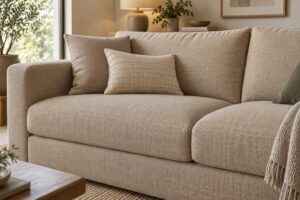
Choose beige fabric for upholstery by checking shade, texture, cleaning needs and batch consistency.
View details