 Elitesofabric
Easy Clean Upholstery Fabric
0Compare upholstery surface, pile, color, and care limits to choose easy clean sofa material for everyday use.
View details
Search the whole station
An old sofa that has seen better days isn’t simply made usable again by just replacing the fabric with something new and pretty. What truly affects the outcome is often hidden beneath the surface: whether the frame has loosened, whether the suspension has failed, whether the foam has degraded into powder, and whether the moving mechanisms still operate smoothly. If internal issues are not addressed first, the new fabric may quickly become loose, develop stress at the seams, or show localized wear.

Thinking of “best fabric for reupholstering a sofa” as a simple ranking of materials can easily lead to the wrong choice. Cotton, polyester, velvet, or loop pile fabrics cannot be judged as suitable solely based on their names. A more practical approach to fabric selection is to systematically eliminate incompatible candidate fabrics by evaluating factors such as furniture structure, construction methods, typical daily loads, and maintenance requirements.
First, inspect the frame, springs or suspension, foam, hardware, and connection points. An aged appearance alone does not prove that a piece of furniture is worth restoring; similarly, a torn fabric cover does not necessarily mean the internal structure has become unusable. Only by comparing the estimated remaining service life, new fabric options, construction costs, and interior repair expenses can you decide whether to reupholster the entire piece, perform localized repairs, add a removable cover, or replace the entire piece of furniture outright.
For sofas with recliners, folding mechanisms, or modular configurations, also check the required space for movement. Once the thickness, seam locations, fixing points, or excess fabric edges of a new material enter the mechanism, they may affect folding, unfolding, and joining. It is far more reliable to have the contractor confirm the existing structural conditions before construction begins than to try to accommodate them after the materials have been purchased.
The same fabric may look appropriate on a flat sample card, but its appearance can be entirely different when applied to armrests, deep welting, piping, or tight-radius corners. Fixed fabric conversion must account for cutting, sewing, corner folding, tacking, curved surface fitting, and seam load-bearing capacity. Prior to procurement, confirm with the contractor the acceptable width, backing material, elongation, thickness, orientation, and fixing method.
For furniture with many curved surfaces or tight wraps, it is best to use a sufficiently large sample piece to test bending, stitching, or wrapping on similar structures. Small color swatches can only help with a preliminary assessment of color and texture; they cannot confirm that the fabric will not develop hard lumps at folded corners, nor can they verify that seams and stress points meet the required standards.
Durability is not a single number. First, consider what this sofa is most likely to encounter: long-term friction on the seat, pilling on the surface, snagging from pets, seam unraveling, nap flattening, fading from strong light, or changes in appearance due to frequent cleaning. Each type of risk requires verification of different information.
In addition to wear resistance, high-frequency seat surfaces should also be evaluated for pilling, tear strength, seam slippage, and colorfastness to rubbing. When you have children or pets at home, you can list snagging, staining, allowable cleaning agents, and maintenance schedules in a single comparison chart. A tightly woven surface can serve as an initial screening criterion to minimize exposed yarns and the risk of snagging, but it does not replace physical sample inspection, nor can it be used to guarantee that the fabric will not snag.
When you see terms such as “easy to clean,” “stain-resistant,” “washable,” or “high-performance,” follow up by asking for details on the testing methods, types of stains they are effective against, cleaning procedures, number of repetitions, and any applicable limitations. Water repellency, stain resistance, stain release, and washability are not the same thing. While the fabric surface is easy to wipe clean, this does not mean that the backing, seams, or internal padding are suitable for extensive wetting.
The actual quantity required cannot be estimated solely based on the number of two-seater or three-seater units. Armrest width, backrest height, number of cushions, skirt edging, deep buttoning, and the shape of the fabric pieces will all affect the amount of material required. After determining the actual net fabric width, repeat length, nap direction, and pattern matching scheme, the layout should be carried out piece by piece, and then reviewed by the plate-making or construction team responsible.
Plain, non-directional fabrics generally allow for more flexible rotation and nesting of pattern pieces; stripes, checks, large prints, herringbone, velvets, and directional chenilles, on the other hand, restrict rotation and may increase fabric waste due to matching requirements. Wider fabric can sometimes reduce the number of seams, but it does not necessarily reduce the total length or the overall cost. If the largest visible piece exceeds the net fabric width, the placement of seams and the pattern continuity should be determined before placing the order.
For final approval, don’t just look at web images or a small color swatch. The sample area should be large enough to display the complete pattern, color distribution, and pile direction, and it should be placed on the horizontal seat surface, the vertical backrest, and the curved armrest for observation. Different incident light angles and surface orientations can alter color, gloss, and texture, with these effects being particularly pronounced on suede.
Re‑inspect the front and back sides, thickness, opacity, stretchability and recovery, whether the edges tend to fray, and the condition of the seam openings. Only by applying the expected types of soiling, the permitted cleaning methods, and identical friction conditions to the candidate samples can the conclusions drawn be relevant to this sofa. When replacing fabric in bulk or working on furniture from the same set, first complete the initial piece to confirm the nap direction, pattern matching, curve adherence, stress points, and care instructions before proceeding with materials from the same batch.
Please include the furniture component, style number, composition, structure, fabric width, areal weight, color batch, finishing treatment, backing material, performance specifications, and care instructions on the same confirmation form. Price comparisons should also use the same unit of measurement and layout plan, and account for pattern-matching waste, construction complexity, cleaning and maintenance requirements, and the risk of future reordering.
Finally, the contractor shall confirm in writing the material quantities and processing feasibility based on the furniture specifications, actual fabric dimensions, and cutting layout. After completing this step, buying the fabric will help you avoid rework more effectively than simply choosing a material name that sounds durable.
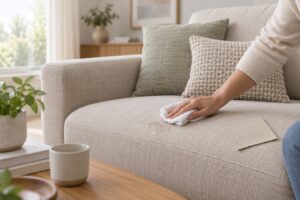
Compare upholstery surface, pile, color, and care limits to choose easy clean sofa material for everyday use.
View details
Learn how to clean a fabric chair by checking care codes, testing hidden areas, and controlling moisture and friction.
View details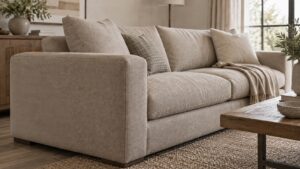
Learn how to assess canvas fabric for sofa use by checking weave, fiber content, seams, care, and sample performance.
View details
Plan boucle fabric sofa design by matching loop texture, color, seams, furniture curves, and maintenance needs.
View details