 Elitesofabric
Anti Scratch Sofa Fabric: What To Check Before Buying
0Choose Anti Scratch Sofa Fabric By Checking Weave, Snag Risk, Test Evidence, Cleaning Limits, And Real Samples.
View details
Search the whole station
With a cat or dog at home, the sofa cloth selection can easily be skewed by a blanket “pet-friendly” label. Dogs will jump on the seat surface, bringing hair and footprints, while cat claws may catch the surface yarn. Drinking water, grease, urine or vomit corresponds to different cleaning problems. What you really want to choose is not 1 material that takes care of all the risks, but a fabric that is easier to maintain and more controllable under your own major risks.

When selecting the best fabric for pets sofa, first write down the pet’s behavior, sofa usage frequency and acceptable maintenance methods, and then check the actual samples one by one. Only by “polyester”, “microfiber” or “high-performance fabric” and other names, can not judge the finished hook silk, pilling, seams and cleaning performance.
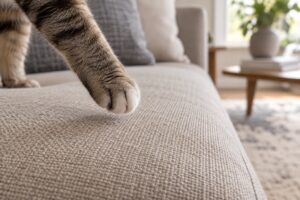
Put the sample cloth flat and observe from the front and slope under the sunlight and indoor lights. Obvious loose loops, long floating threads, raised embroidery threads and deep textures are more likely to leave the tips of the claws in place, and may also hook the brush during hair removal. Fluffy bouclé, some chenille or long velvet fabrics are not all useless, but the decision cannot be made only by soft hand feeling. It depends on whether the specific structure is tight, whether the ring is exposed, and whether the yarn will be brought up after a slight touch.
A flat, tight, lint surface is usually easier to remove particles and hair, and may also reduce some chances of hooking. However, “reduction” does not equate to scratch prevention. Pet claw grasping is the result of the joint action of claw shape, angle, load, number and fabric structure. The so-called anti-grasping conclusion without these conditions is not reliable. Sofa still need to cooperate with grab plate, nail management and vulnerable parts protection.
Not showing hair and being easy to remove hair are not the same thing. The stronger the contrast between the color of the hair and the color of the fabric, the more striking a small amount of hair; fluff, three-dimensional texture or deep grooves may also trap the hair on the surface. It is more valuable to put a small amount of hair actually dropped by pets on the candidate sample cloth and treat it with the suction head or hair removal tool planned to be used for a long time than to look at a clean sample card.
Pay attention to the tool itself when operating. A stiff brush, an overviscous roller, or a high suction narrow tip may pull out the yarn, change the lint direction, or leave localized wear marks. The sample cloth test depends not only on how much hair is left, but also on whether there is fluffing, hooking or luster difference after cleaning.
Liquids, oils, urine, vomit and odors common in pet households cannot be covered by a “easy to clean” conclusion. Confirm with the supplier the care code of the finished product, the allowed cleaning media, whether professional handling is required, and whether there are additional restrictions on backing, coating and seams. The presence of zipper does not mean that the cover can be washed with water. Even if washing is explicitly allowed, check the size, skew, color, pilling, zipper and re-suit performance after washing.
When pre-testing a small sample of the batch to be purchased, the type of dirt, residence time, number of treatments and changes after drying should be recorded. After partial cleaning, check for fading, hardening, ring marks, poor lint or change in backing. The fixed soft bag also includes foam, glue layer and wooden frame. The surface can withstand certain cleaning agents, which does not mean that the whole sofa can be deeply soaked.
When the pet frequently goes up and down the sofa, the front edge of the seat surface, the cushion and the outer side of the armrest will bear friction, local tension and seam stress at the same time. In addition to the wear resistance results, check the pilling, breaking strength, seam slippage, color fastness to dry and wet rubbing, and appearance after repeated cleaning. Wear performance is good, still may occur fluffing, hook silk, seam opening or fluff lodging.
The test report shall also state the method, sample condition, direction, unit and determination end point. The number of times obtained by different methods cannot be directly sorted horizontally; if the pet claw is simulated internally, the claw shape, load, angle, number of cycles and appearance end point should also be stated, and this simulation cannot be regarded as a general certification.
The same cloth is used on cushions, backrests or decorative pillows, and the risks are not the same. The high-frequency seat surface pays more attention to wear resistance, pilling, seams and cleaning durability; decorative pillows can consider touch and pattern more. The fixed cover and the removable cover are also evaluated separately: the former focuses on stapling, curved cover and seam stability, and the latter also involves post-wash size, zipper, stretch recovery and re-fit.
Finally, request a sample of the target batch and complete a small-scale verification under pet hair, planned hair removal tools and one of the most common soil conditions. See the color, surface and seam changes after drying, and then decide whether to use for high-frequency parts. This option does not promise “absolute anti-catch”, but puts the most common maintenance work and failure risks on the table in advance.
Choose Anti Scratch Sofa Fabric By Checking Weave, Snag Risk, Test Evidence, Cleaning Limits, And Real Samples.
View details
Choose The Best Fabric For Family Sofa Durability Stain Resistance Comfort Using Care Limits, Samples, And Evidence.
View details
Learn how to assess canvas fabric for sofa use by checking weave, fiber content, seams, care, and sample performance.
View details
Learn how to clean a fabric chair by checking care codes, testing hidden areas, and controlling moisture and friction.
View details