 Elitesofabric
How much fabric do you need to buy for the renovation of old sofas?
0Estimate the amount of fabric to reupholster sofa projects by checking panels, usable width, nap, repeats, and waste.
View details
Search the whole station
Canvas fabric for sofas is often understood as a thick, durable upholstery fabric; however, “canvas” primarily refers to a plain-weave construction that tends to be relatively heavy, without specifying the fiber content or automatically implying a particular level of abrasion resistance, pilling resistance, or ease of cleaning. Cotton, polyester, or blended fabrics can all produce a canvas-like appearance; the actual performance will also be influenced by the yarn type, warp and weft density, finishing processes, and backing.
This is also the most easily overlooked factor when choosing canvas sofa fabric: two fabrics that look similar may differ significantly in texture, resilience, seam stability, and cleaning requirements. The simple, well-defined weave is well suited for creating natural, understated furniture surfaces; however, whether it is appropriate for the seat, backrest, or armrest depends on the specific design and the particular part of the piece.
Residential spaces with low-frequency use, such as bedrooms, and high-frequency areas like living rooms and common spaces, have different requirements for upholstery fabrics. The seat surface is subjected to sustained seating pressure, friction, seam tensile forces, and contamination, and therefore typically requires greater attention to its performance in terms of abrasion resistance, pilling, seam slippage, and cleanability compared to side panels or decorative cushions. Bright light, children, pets, and the amount of time you can dedicate to maintenance will also affect your priorities.
If you have a cat at home, you can’t simply call a fabric the “best fabric for cats sofa” or “cat scratch resistant sofa fabric” just because it has a tightly woven texture. Fewer exposed loops and a tighter structure can serve as initial screening criteria, but it is still necessary to inspect the surface for fuzzing, snagging tendency, pilling, seams, and any changes in the sample after being caught or snagged. Any “scratch-resistant” or “pet-friendly” claims should specify the evaluation methods, the types of damage they address, and any usage limitations.
A specification for evaluation should clearly state the fiber composition and its proportions, plain weave structure, yarn type, warp and weft density, usable fabric width, mass per unit area, thickness, finishing treatment, backing, color batch, and the designated furniture part. Thickness or weight only indicates the material’s thickness or sense of mass; they cannot substitute for data on strength, seam integrity, and durability.
Performance data must also be kept complete. Wear resistance results must be interpreted in conjunction with the test method, applied pressure, abrasive material, end point, and specimen orientation; Martindale cycle counts cannot be directly converted to Wyzenbeek double-rub counts. Pilling, breaking strength, seam slippage, dry and wet rubbing colorfastness, and light fastness each correspond to different risks and cannot be summarized by a single high abrasion resistance value.
When it comes to cleaning, you shouldn’t just focus on how “easy it is to maintain.” Stain resistance, soil resistance, stain release, and washability are not the same thing. Prior to procurement, confirm the permissible cleaning agents, cleaning methods, drying requirements, as well as any changes in color, hand feel, and dimensions of the fabric, backing, and seams after cleaning. When there is no clear care guidance, excessive humidification, vigorous scrubbing, or high-temperature treatment may result in watermarks, pilling, discoloration, or delamination.
Small color swatches are suitable for assessing color and getting a preliminary sense of the texture, but they are insufficient for revealing the full fabric width, batch-to-batch variations, or the true appearance of the coating. A more reliable approach is to obtain a sufficiently large sample and place it separately on the horizontal seat, the vertical backrest, and the curved armrest for observation. Additionally, inspect both sides of the fabric, as well as its warp and weft directions, opacity, and its ability to stretch and recover.
When replacing the fabric, the contractor must also perform trial bends, trial seams, or trial wraps. If the canvas is too thick, it may form overlapping, stiff folds at the corners; if it is too thin, the underlying contours may show through. Loose edges, pinholes, rolled hems, tacking, and tight-radius folds all need to be verified on similar structures. The actual yardage required should be determined based on the available fabric width, the dimensions of each cut piece, seam allowances, the lay‑out direction, and the placement strategy for avoiding defects; it should not be calculated solely by applying a fixed yardage per sofa seat.
The right canvas is not the one with the most prestigious name or the highest single-value rating, but rather a specific fabric that simultaneously meets the requirements for appearance, feel, structure, performance, and maintenance in the intended furniture application. Clearly list the scenarios and specifications, then use actual samples to verify the seams, hanging, cleaning, and construction performance, only then can you determine whether a product labeled as “cat-friendly fabric for sofas” is truly suitable for your household.
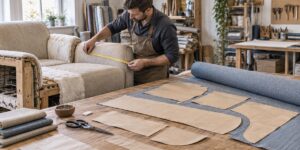
Estimate the amount of fabric to reupholster sofa projects by checking panels, usable width, nap, repeats, and waste.
View details
Compare Best Stain-Resistant Sofa Fabrics For Families With Kids By Stain Tests, Cleaning Limits, And Durability.
View details
Plan boucle fabric sofa design by matching loop texture, color, seams, furniture curves, and maintenance needs.
View details
Learn how to clean a fabric chair by checking care codes, testing hidden areas, and controlling moisture and friction.
View details