 Elitesofabric
Can A Leather Sofa Be Reupholstered In Fabric?
0Find out: can a leather sofa be reupholstered in fabric? Check its cover, foam, frame, and fixing structure first.
View details
Search the whole station
When the household steam engine is placed next to the sofa, the most likely misjudgment is that the equipment can handle the surface of the soft bag, which is equivalent to the sofa allowing steam cleaning. In fact, the heat, moisture and pressure generated by the equipment will act on the table cloth, backing, adhesive layer, foam, seams and even adjacent wood finishes at the same time. The surface looks clean for a while, which does not indicate that there is no moisture or material change inside.

Some people will directly ask can you steam clean fabric sofas, but what really needs to be confirmed is not whether the machine has steam or not, but whether the sofa care instructions allow this temperature, water content and treatment method. Without these conditions, don’t use the entire sofa as a test subject just yet.
Steam cleaning may refer to dry steam, hot water pumping, and some are just marketing names for equipment. The actual temperature and amount of water brought to the fabric by the three are not the same, and whether the moisture is extracted simultaneously will also directly affect the degree of moisture of the backing and filling.
Check the equipment description first to find out the outlet mode, temperature range, spray volume, pressure and extraction capacity. Just writing that it applies to the upholstery is not enough to prove that it is suitable for your sofa model. Just because a household machine can operate doesn’t mean the fabric is suitable for this method.
First, locate the care label and model specifications on the furniture. In common codes, W usually means that water-based cleaners can be used as specified, S means that solvent-based cleaners that do not contain water are used, WS means that one of them can be used, and X is usually limited to vacuuming, brushing or professional treatment. These codes describe the range of cleaning media and do not directly permit steam temperature, water volume, or full-surface deep cleaning.
Even if W is seen, continue to confirm whether heat treatment, machine treatment and fixed soft bag pumping are allowed. The presence of a zipper also does not mean that the cover can be removed and washed. If the treatment instructions do not cover steam or hot water pumping, it is more prudent to confirm with the furniture manufacturer or professional cleaning staff than to infer from the fiber name.
High temperatures may deform heat-sensitive fibers and may also affect dyes, prints, coatings and adhesive layers. Excessive or insufficient extraction of water may bring dirt, dyes, finishing agents or soluble substances in the filling to the edge of the wet area, forming water circles, rewet spots or light and dark differences after drying.
The fixed sofa still has a multi-layer structure. The surface is dry to the touch, and the foam and backing may still contain water; after that, it appears stiff, sticky, odorous or slow drying, which may be related to residual cleaning agent, internal water ingress or insufficient ventilation.
Suede, loop, printed, multi-colored or backed fabrics, with extra attention to changes in pile direction, snagging, color migration and inter-layer detachment. Changes caused by heat and moisture do not necessarily appear immediately, and you cannot just look at the surface that has just been treated.
After the nursing instructions clearly allow the corresponding methods, first do a small-scale pre-test in an inconspicuous position. The planned temperature, water volume, detergent concentration and mechanical action should be used in the pre-test, and the strength should not be increased on the front after the test with milder conditions.
After treatment, fully extract the residue and wait for the layers to dry completely before checking the color, feel, lint, watermark, seams, backing and odor. When the color appears after the white cloth is wiped, it should be stopped first; this may be the transfer of dirt, or the dye or printing of the fabric itself is falling off. The absence of immediate effects in small areas does not prove that large-area, prolonged, or repeated exposure is necessarily safe.
Steam equipment may use high temperature or sanitary effects as a selling point, but the outlet temperature of the equipment is not equal to the temperature actually reached and maintained on the surface of the fabric. To form a credible health conclusion, it is also necessary to verify the actual temperature of the material, the holding time, the uniformity of coverage and the target microorganism, and to evaluate the heat and moisture damage. Most households begin their daily maintenance by vacuuming, removing loose particles, and promptly cleaning up spills. Cleaning, reducing microorganisms and disinfection are not the same thing; keeping the soft bag hot and humid for a long time in order to pursue disinfection may conflict with the requirement to avoid over-wetting.
Confirm that the nursing instructions allow, the equipment type is clear, and there is no abnormality after pre-test drying before entering the actual treatment. The operating range should have a natural boundary, and the spraying, mechanical action and extraction should be kept as uniform as possible, avoiding repeated heating, adding water or rubbing on a stain. After the end of the treatment, strengthen the ventilation, let the table cloth, backing and filling fully dry, and then judge whether the need for a second treatment.
If the label is S or X, the material and backing are unknown, the color has faded or delaminated, the interior is damp, or the equipment cannot effectively extract water, you should not continue to steam clean yourself. First confirm what the sofa allows, and then decide what machine to use. This sequence is more reliable than pushing the sofa backwards from the equipment function.
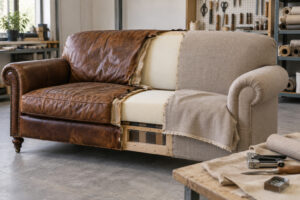
Find out: can a leather sofa be reupholstered in fabric? Check its cover, foam, frame, and fixing structure first.
View details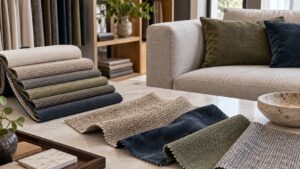
Learn how to assess best quality sofa fabric through use, testing, samples, care, and batch consistency.
View details
Can we change sofa fabric? Learn how to assess the frame, upholstery method, fabric fit, yardage, and final checks.
View details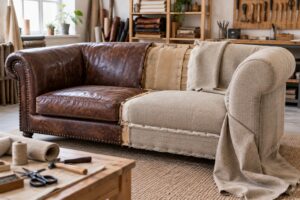
Learn can you recover a leather sofa with fabric by checking its structure, padding, fixing points, and fabric fit.
View details