 Elitesofabric
Best Cleaning Solution for Fabric Sofa: Choose Safely
0Choose the best cleaning solution for fabric sofa by checking the care code, stain type, and material limits first.
View details
Search the whole station
A bench looks like it has only a flat seat surface, but it is easy to focus on the color and feel when changing the cloth. Once it is put into actual use, the areas that typically show signs of wear first are the frequently occupied seats, the front edges of the seats, the corners, and the fixed edges. Whether the fabric is suitable or not should be judged from how these parts are stressed, how to clean and how to close the edge.
Don’t just choose fabric based on the name “bench.” The seat pressure, friction, stain type and cleaning frequency may be different for the shoe changing stool in the entrance, the bench near the dining table and the bed end stool used at low frequency. First, record who will use it, how often it will be used every day, whether it is in frequent contact with food and beverages, whether there are children or pets, and whether the seat can be removed. This is how we can break down “durability” into inspectable criteria.

The seat is a load-bearing, high-friction area and should not be judged solely by the performance of the backrest or decorative cushions. When using high frequency, the wear resistance, pilling, seam slippage, color stability under dry and wet friction, and appearance changes after repeated cleaning should be checked at the same time. A high single wear number does not mean that the fabric will not fluff, pilling, or shift near the seam.
When selecting bench fabric, it’s best to lay the sample across the seat and the front edge, rather than just folding it in your hand. Observe the surface for obvious loops or long floating lines that are easily caught by sharp objects, and then use normal indoor light to see the texture, color and direction changes. For suede or directional materials, different cutting directions may show differences in light and dark; adjacent visible faces of the same bench should be in the same direction.
Soft touch can be an important condition, but it is not a substitute for structural inspection. Thick and fluffy materials are not necessarily more wear-resistant, and higher gram weights do not automatically mean more stable seams. Ask the supplier for specific color fiber, woven or knitted structure, backing, finishing and applicable test information, and confirm that the report corresponds to the current batch, rather than only accepting the designation “furniture grade” or “high performance.
First find out whether the existing covering is a detachable cushion cover, stitched and fixed table cloth, or a fabric nailed to the seat plate. Fixed wraps focus on stapling, seams and long-term tension; removable covers also check dimensional stability, zippers, disassembly and care methods. The two paths cannot share a single, sweeping conclusion.
There are not many bench cuts, and it does not mean that the construction must be simple. Tight corners, hard seat edges and concentrated sitting pressure will amplify loose edges, seam slippage and fixed strength problems. Try to fold the candidate sample cloth on the filling and edge of the actual thickness to check whether the corner forms too thick hard package, whether the surface is stretched and deformed, and whether the fixed position is easy to fall off. Before formal cutting, the front and back sides, roll direction, nap direction, and mirror-image relationships should also be marked.
Maintain the normal assembly of the bench during the measurement, and record the seat surface, side, fold-back path and seam allowance respectively. Old cloth can provide clues to the cut, but if it has been stretched, shrunk or torn, it cannot be used as a new template without correction.
The order length is also influenced by the available net fabric width, pattern repeat, nap direction, cutting layout orientation, unusable selvage edges, and defect avoidance. Patterned or directional fabrics may not be able to rotate at will in order to save cloth. If the same project uses multiple volumes, the volume number, batch, net width and color should also correspond to the specific furniture, leaving the same batch of surplus materials for subsequent repairs will be more secure.
Color resistance does not mean easy maintenance. A flat, tight, lush surface is usually easier to remove loose particles, but whether the stain can be treated still depends on the finishing, soil type, joints and care instructions. The zipper does not mean that the cover can be washed with water; whether it is removable, washable or machine washable must be confirmed by the finished product care requirements.
Loose particles can be removed daily with a tool compatible with the surface. Absorb the liquid in time according to the nursing instructions after splashing, confirm whether water-based or solvent-based methods are allowed before treatment, and test in an inconspicuous position first. Excessive wetting or repeated vigorous rubbing may leave watermarks, alter the nap direction, and even cause the backing and padding to dry slowly.
Finally, the candidate sample cloth is brought back to the bench, and the angle, direction, cleaning method and test data are checked item by item. If you can’t say anything clearly, don’t place an order according to the appearance.
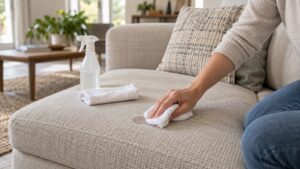
Choose the best cleaning solution for fabric sofa by checking the care code, stain type, and material limits first.
View details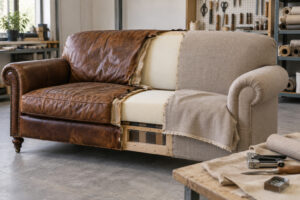
Find out: can a leather sofa be reupholstered in fabric? Check its cover, foam, frame, and fixing structure first.
View details
Choose bar stool upholstery fabric by checking wear, seams, texture, cleaning limits, and installation needs.
View details
Choose the best fabric for sofa slipcovers by checking fit, stretch recovery, seams, wash stability, and care limits.
View details