 Elitesofabric
Best Hard-Wearing Fabric for Sofas: What to Check
0Compare best hard wearing fabric for sofas through test methods, wear reports, seam checks, and care requirements.
View details
Search the whole station
Adding a removable slipcover to the sofa looks simpler than reupholstering: you don’t have to remove the nails, and you can easily replace it when your aesthetic preferences or maintenance needs change. However, what truly affects the user experience is rarely whether the fabric name sounds “premium”; rather, it’s whether the cover can conform snugly to the furniture’s contours, whether it sags after being sat on, and whether it can still be easily slipped back on after washing.

Before choosing the fabric, first take a look at the sofa itself. Wide armrests, high backrests, corner modules, fixed cushions, and individual cushions each require different patterns. If you only purchase the “single-seat” or “three-seat” versions, you’re likely to encounter issues such as seams misaligned with the edges, uneven hemlines, or the slipcover constantly slipping out of the gaps.
General-purpose stretch covers, universal slipcovers, and custom-fit covers tailored to specific furniture all have different fabric requirements. The elastic cover relies on stretching to wrap the curved surface, the loose cover pays more attention to the pendant, size and fixing method, and the customized cover needs to implement the furniture outline, plug seam, hem, zipper and cushion activities on the version.
First determine the coverage method, then discuss the materials. The table cloth fixed on the furniture should adapt to stapling, folding angle and long-term stress. The movable cover also undergoes repeated disassembly, sliding and possible washing. Just because a particular fabric is suitable for a fixed upholstery does not mean it is naturally suitable for a removable sofa cover.
When comparing the best fabrics for sofa slipcovers, don’t just ask whether the fabric is stretchy. The more useful questions are: in which direction it stretches, how much it needs to stretch when it reaches the size of the furniture, and to what extent it can recover after unloading. Knitted structures, elastic yarns, fabric weave or finishing may all provide extensibility, but “stretchable” by itself does not indicate recovery.
Insufficient elasticity may make it difficult for the cover to pass over the armrest or backrest; excessive stretching for installation may subject the seams and zippers to concentrated loads. Insufficient backfilling can cause the seating surface to gradually sag, wrinkle, or accumulate fabric. Unidirectional and bidirectional stretch fabrics can also alter the grainline of pattern pieces; do not rotate them arbitrarily in an attempt to save fabric.
When the sample is obtained, the extension and rebound can be observed in the predetermined direction, and the similar curved surface can be tested with a large enough sample. A small sample that looks suitable when laid flat cannot prove that it can still maintain its appearance at the corners of the armrest, the edge of the seat cushion and the position of the plug seam.
The load borne by different parts of a sofa cover is not the same. The seat surface and cushion are repeatedly subjected to sitting pressure, friction, joint tension and pollution. The backrest, side panels and skirt can adopt different performance priorities. Therefore, one should not substitute a comprehensive judgment with terms such as “thick,” “heavy,” or a single wear-resistance value.
Wear resistance, pilling, snagging, tensile strength, and seam slippage are distinct issues. A high abrasion resistance rating does not mean the fabric will not pill, nor does it guarantee that the seams will remain intact. When there are long floating lines, open rings or long fluff on the surface, pay attention to the appearance changes after hooking and friction. The performance of seams is related to the direction of the cut, the stitch, the stitch, the seam, the seam and the curvature of the furniture.
The fiber composition, fabric structure, width, mass per unit area, proposed use, test results and care limitations of the specific model should be considered together before procurement. Only by the name of “sand release”, “high performance” or “easy to clean”, it is impossible to confirm that it is suitable for the force and disassembly of the cover.
Removable doesn’t mean washable, and having a zipper doesn’t mean it’s machine-washable. The cleaning code indicates the range of cleaning media permitted and does not provide a separate indication that the complete cover can be removed, washed, dried and re-fitted.
If the convenience of maintenance is the focus of purchase, check the clear washing program, temperature, detergent, drying method and cycle conditions on request. What is more critical is the verification of the finished product in the sewing state: after washing, not only the length and width, but also the skew, color, pilling, seams, zippers and reset performance should be checked. The dimensional stability of the fabric sample does not guarantee that the entire finished garment can be reassembled with the same fit.
During actual use, it is best to care for each part as a set and reassemble only after they are completely dry. Washing only the more heavily soiled piece may result in dimensional or color differences between the various components. When installing the sleeve, it should be inserted segment by segment according to the marking direction, and spread evenly. Do not pull the zipper with a single point, and do not use sharp tools to plug the gap.
Keep the normal assembly state and cushion position of the sofa during measurement, and record the total width of the furniture, seat width, seat depth, backrest height, armrest width and height, skirt position, cushion quantity and the size of each independent cushion respectively. The fitting cover shall also record the position of the plug seam, hem, seam allowance and closure. Even two sofas with similar overall dimensions may still have incompatible frame designs.
The quantity cannot be estimated solely based on the number of seats. The actual width, cut shape, stretch direction, floral return, velvet direction, floral position and allowable seams will change the layout. Stripes, checks, large flowers or directional suede especially need to determine the center of the pattern and the unified direction, otherwise the material will be underestimated according to the undirected plain color estimation.
It’s best to make a sample or a trial fit before custom-making a cover. Check whether the seam falls on the edge of the furniture, whether the cushion can move normally, whether the hem is smooth, whether the plug seam is still stable after sitting down and getting up, and then approve the formal fabric. This step can expose the problems between version, stretching direction and furniture contour more than ordering directly according to sample feel.
Suitable sofa cover fabric is the result of a balance in the specific cover type, furniture size and care conditions. Change “can you pull up” to “can you recover after stretching”, change “can you wash” to “can you reset after washing the whole set”, and then check the seam, surface, direction and batch item by item. Taking these questions to see physical samples and test sets is usually more reliable than deciding on cotton, polyester, velvet or other names first.
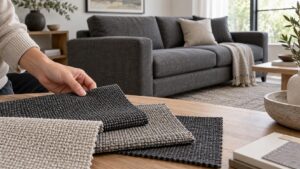
Compare best hard wearing fabric for sofas through test methods, wear reports, seam checks, and care requirements.
View details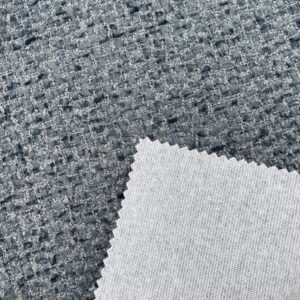
Explore polyester velvet, jacquard, printed, embossed, and woven upholstery fabrics. Compare six designs and request samples or a project quote.
View details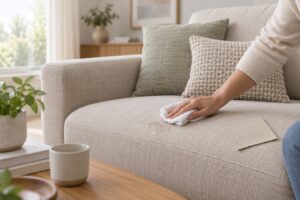
Compare upholstery surface, pile, color, and care limits to choose easy clean sofa material for everyday use.
View details
Learn how to clean a fabric chair by checking care codes, testing hidden areas, and controlling moisture and friction.
View details