 Elitesofabric
Can You Recover a Leather Sofa with Fabric?
0Learn can you recover a leather sofa with fabric by checking its structure, padding, fixing points, and fabric fit.
View details
Search the whole station
Although the seat surface of the bar stool is not large, it is often easy to be biased by color and feel when selecting fabrics. The stool is pulled out, sat down, turned, and pushed back every day. The places where the stress is really repeated are often the front, corners and seams of the stool. Looking at the thick fabric, it may not be appropriate to make small arc hemming. The small sample feels soft, which does not mean that it can remain the same after long-term friction.

Before picking the fabric, find out where the stool is, who will use it and how often it will be used. Compared with the dining space used by high frequency, the occasional sitting on the breakfast table at home has completely different requirements for abrasion resistance, pilling resistance, seam fastness and cleaning and maintenance. In addition, the seat surface, backrest and decorative parts cannot be measured by the same set of standards: the seat surface must always bear weight pressure and friction, and the front edge must GG1 be scratched by clothes; The backrest may pay more attention to hand feeling and color value.
It would be very helpful to list the potential problems you might actually encounter. For example, if you often eat and drink nearby, you have to put anti-fouling treatment, supporting cleaning methods and drying conditions in the first place. If you often have metal pendants on your clothes or have pets at home, you should pay more attention to whether the fabric will be hooked or picked. Clarify the problem first before selecting materials; your thinking will become much clearer.
The fiber name on the ingredient label only indicates what the cloth is made. What really determines the performance of the finished product is the yarn shape, the weave structure (woven or knitted), the surface fluff state, and the base fabric and finishing process. Even if the label says “polyester fiber” (polyester), they may eventually be made into flat weave, jacquard, imitation leather velvet or terry surface, and the feel and care methods can be very different.
When picking fabrics for bar stools, you may as well use your naked eyes to see if there are any obvious long floating lines, loose terry loops, or bumps that are easily caught by sharp objects on the surface. The tightness of the weave can serve as a preliminary screening criterion, but it cannot replace specific product test data. In case of high-frequency use, it is best to find a supplier to verify the test report of the specific model-abrasion resistance, pilling resistance, seam slippage, color fastness to dry and wet rubbing, etc., and also to ask under what test conditions and applicable parts these data are obtained. Don’t think that a single item of “high abrasion resistance” will be all right. It doesn’t mean that the fabric will not pilling, hook silk or crack at the seams.
Many fabrics claim to be “easy to clean”, but if you don’t tell you which stains to apply, the time limit for cleaning, what detergent to use and how to operate them, the help of such promises is actually very limited. Be sure to make clear before buying: Is the seat surface fixed or washable? Is it allowed to be washed with water or only by other specific methods? What chemical solvents are absolutely untouchable? Are there any special taboos on the base cloth, the adhesive layer or the fluff on the surface?
After getting the sample cloth, you can first take the leftoffs that do not affect the regular materials and test them according to the instructions to see if the color, hand feeling, fluff direction and surface structure will change after cleaning. Don’t rub it back and forth when decontaminating locally. Don’t mix cleaners until you know the instructions. For those fixed and dead soft stools, once the water seeps too much, moisture will get into the base cloth and filler. At this time, even if the surface is dry, it does not mean that the inside is dry.
The seating surface of the bar stool is usually relatively narrow, often with small rounded corners, inlays or sharp turns. If the fabric is too thick, a hard bag will bulge when stacked at the corner. If the stretch and resilience of the fabric are not good, the bag will easily sag and wrinkle, or the edge line will be directly crooked. It is difficult to predict these problems by looking at the small pieces of 1 cloth that are tiled.
It is suggested to confirm the size of the seat surface and backrest, the position where the edge is easy to wear, the radius of the arc surface and the splicing alignment, and then let the construction party take a large enough cloth sample to try bending and splicing, or simply make a local test package. Let’s see if there is any thread stripping (yarn displacement) near the line. The corners are unconformable and the direction of the surface texture is correct. For example, suede, stripes, lattices, or fabrics with unidirectional patterns with inverted wool have to be typeset in advance to determine the cutting direction. Sometimes, in order to save cloth, the finished product may have embarrassing color difference or pattern dislocation.
In the final decision, don’t just stay on the pictures on the web page or 1 small cut-out samples. Be sure to look at the actual color, thickness, concealment, stretching and rebound feeling, the difference between front and back, and maintenance instructions of the large batch, and take the sample cloth around the bar to see the effect in the real light environment. Light-colored fabrics are indeed more likely to show dirt and are easily contaminated by other colors (color migration). However, dark fabrics are also troublesome, which will make dust, hair or wear marks become particularly conspicuous. In fact, there is no absolute good or bad, only to see its maintenance costs with your daily habits.
Before placing an order, align and confirm the final selected model, batch number, applicable parts, typesetting direction, splicing proofing and cleaning taboos with the construction party. Only when this cloth successfully passes the process test on the real seat structure, and its care can you stick to it for a long time, it is really suitable for your bar stool.
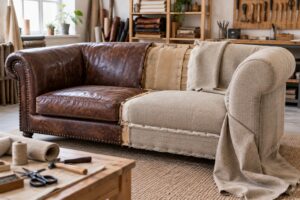
Learn can you recover a leather sofa with fabric by checking its structure, padding, fixing points, and fabric fit.
View details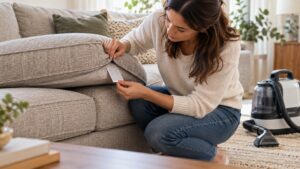
Can You Steam Clean Fabric Sofas Safely? Check Care Codes, Heat, Moisture, Extraction, And Drying Before You Begin.
View details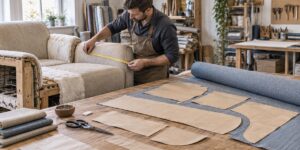
Estimate the amount of fabric to reupholster sofa projects by checking panels, usable width, nap, repeats, and waste.
View details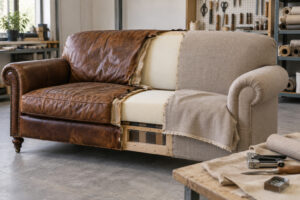
Find out: can a leather sofa be reupholstered in fabric? Check its cover, foam, frame, and fixing structure first.
View details