 Elitesofabric
Best Stain Resistant Sofa Fabrics: What to Check
0Compare Best Stain Resistant Sofa Fabrics By Stain Type, Cleaning Limits, Test Evidence, And Repeat-Care Performance.
View details
Search the whole station
A small sample of loop velvet is held in hand, and it is easy for people to feel that “there must be texture on the sofa”. When it comes to actually upholstering furniture, the final result is determined by more than just the color. How big the seat surface is, how fast the armrest turns, and where the seams fall will change the way this three-dimensional surface is seen and used.
Boucle fabric sofa design should be done safely. The starting point is not to choose a good-looking space effect map, but to judge the fabric surface, furniture outline and daily load on the same map.

Bouclé refers to the fancy yarn with the appearance of knots and loops and the surface style it forms, not the 1 fixed fiber. Two pieces of fabric that look like loop velvet, fiber composition, loop size, thickness, backing and actual performance may be completely different.
A wide, straight backrest or side panel can continuously display the texture, and the shadow change is more complete. When it comes to small radius corners, deep buttons, zipper edges and dense seams, the fluffy surface will be compressed or folded, increasing the risk of bulk, cleaning and hooking. It is not enough to draw soft rounded corners on the design drawing. It is better to take a large enough sample to try bending, sewing or wrapping on a similar curved surface to see if the texture is still uniform and the seam is bloated.
The seating surface, the front edge and the outer side of the armrest are usually subjected to more concentrated friction, sitting pressure and local stress; the backrest, sides and decorative pillows are loaded differently. Even if the whole sofa plans to use the same fabric, it is necessary to confirm the wear resistance, pilling, seam slip, hook wire and cleaning performance of these positions respectively, and the beautiful effect on the backrest cannot be used instead of the seat surface judgment.
The furniture structure will also change the choice. Straight, large surfaces are well-suited for emphasizing a continuous grain texture, while deeply sculpted designs require the fabric to accommodate localized stretching, folding, and shaping. Multiple cushions or corner modules also increase the difficulty of controlling the direction of the cut and the consistency of the batch. First, mark the high-load parts and complex turning points on the furniture drawing, and then decide whether to cover them all, which can avoid detours compared with the details of pre-determination of materials and post-treatment.
The light and dark tones of looped pile are not solely derived from dyeing. Circles, protrusions and surface directions will form shadows under different incident light. The same cloth is placed on the horizontal seat surface, vertical backrest and curved armrest, and the visual depth may be different. This directional appearance is to be seen separately from the true batch color difference.
Don’t just choose beige, gray or brown on the screen, and don’t just look at palm-sized color chips. Place the details in each direction of the sofa and observe them under the sunlight and artificial lighting commonly used in the room. At the same time, compare them close to the wall, floor and wood veneer. The color name covers a wide range of brightness and temperature, and approved physical samples and batch samples are the available benchmarks for subsequent acceptance.
“Soft,” “premium,” or “family-friendly” are not complete specifications. The comfortable touch of the loop velvet will not automatically prove that it is wear-resistant, low-pilling or easy to clean; different exposed loops will also bring different hooking opportunities. When there are children or pets, the surface tightness should be observed with actual samples and compared with the expected dirt, hair, cleaning tools and maintenance frequency. No material name can directly guarantee absolute scratch resistance or low maintenance.
It’s not just the fiber content that needs to be verified with the supplier. Fabric structure, width, mass per unit area, backing, finishing, recommended use, care restrictions, and data on abrasion resistance, pilling, seams, and color fastness consistent with the target site should all correspond to the specific model number or batch. No matter how appealing the marketing labels may be, they cannot replace these conditions.
At the time of final approval, confirm the actual color, front and back, surface direction, batch, complete texture scale, seam sample, care instructions and furniture parts together. The combination sofa should also unify the laying direction and visual reference of each module. The formal dosage will be calculated after the actual width, direction and cutting material arrangement are determined.
Finally, don’t just ask whether this fabric looks good on the sample card. Put it in the most urgent corner, the most frequently seated seat and the real light of the room to see it again: texture, construction and maintenance are acceptable, and the design really falls on the sofa.

Compare Best Stain Resistant Sofa Fabrics By Stain Type, Cleaning Limits, Test Evidence, And Repeat-Care Performance.
View details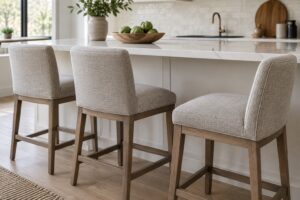
Choose bar stool upholstery fabric by checking wear, seams, texture, cleaning limits, and installation needs.
View details
Choose the best material for a couch by checking use, structure, durability, cleaning limits, and real samples.
View details
Choose the best fabric for furniture by matching use, structure, durability, maintenance, and real sample performance.
View details