 Elitesofabric
Best Fabric for Pets Sofa: A Practical Selection Guide
0Choose the best fabric for pets sofa by checking surface, hair removal, stains, care limits, and durability.
View details
Search the whole station
A piece of sample cloth feels comfortable and does not mean that it will fit on the furniture. The seat surface will be repeatedly subjected to sitting pressure and friction, the edge of the armrest is prone to local wear, and the backrest and side panels are more likely to expose the velvet direction, color difference and pattern direction. When asked about best fabric for furniture, what you are really looking for is not 1 a material that eats all furniture, but a fabric that can adapt to specific parts, frequency of use and maintenance methods.

Load-bearing seat surface is usually to focus on checking wear, pilling, seam slip, pollution and changes after cleaning. Another set of performance priorities can be adopted for the backrest, side panels, skirt edges or decorative pillows with different forces. The dust-proof cloth at the bottom of the furniture, the platform cloth under the seat cushion and the visible decorative table cloth are not the same material, and cannot replace each other just by looking at the similar colors.
Fixed casings and movable covers must also be kept separate. Fixed fabrics should be suitable for cutting, sewing, stapling, curved surface fitting and long-term seam stress. The detachable cover also needs to confirm stretching and recovery, size after washing, zipper and repeated disassembly and assembly. Seeing a zipper does not mean that the cover can be machine washed, and the care instructions must clearly support this practice.
First, think clearly about how this piece of furniture will be used. Low-frequency room chairs, high-frequency family sofas and public space seats face friction, pollution and maintenance tolerance are completely different. Instead of only comparing a very high wear-resistant number, it is better to list the more likely problems: wear-through, pilling, snagging, seam opening, fluff lodging, fading, or leaving a watermark or color difference after cleaning.
Families with children can add actual dirt such as beverages, oily foods and pigments to the sample test. When you have a pet, observe the surface for loose loops that are easily caught by the tips of the claws, and compare hair appearance, dust accessibility, and cleaning restrictions. No material name is automatically equivalent to “anti-scratch” or “easy to clean”.
Polyester has the fiber characteristics of low moisture absorption, fast drying and more wrinkle resistance, but “100% polyester” only indicates the fiber content and cannot prove abrasion resistance, pilling resistance or stain resistance. Cotton and cotton blends can provide different tactile and moisture absorption performance. The dimensional stability, seams and care boundaries of the finished product still depend on the ratio, yarn, fabric structure and finishing. Flax or linen blends are suitable for the direction of preference for crisp appearance and natural luster, but also pay attention to anti-wrinkle, shrinkage and actual maintenance conditions.
Bouclé, canvas, jacquard, velvet and chenille describe different surface, yarn or texture characteristics, not comprehensive quality grades. Obvious loops should be checked for hooking and pilling, suede should be observed for velvet direction, indentation and lodging, and large flower jacquard will affect flowers, seams and dosage. If you like a certain appearance, you can put it in the candidate range first, but don’t let the style name replace the performance data.
The 1 part of the specification that can be used for judgment shall at least state the fiber proportion, woven or knitted structure, width, mass per unit area, color or batch, front and back, pattern direction, finishing and proposed use. The performance data should also indicate the test method, sample condition, direction, unit and result. Martindale and Wyzenbeek belong to different wear-resistant systems, and numbers cannot be directly converted.
Wear resistance is just one of the features. Pilling is related to appearance maintenance, seam slip reflects whether the yarn is displaced at the seam edge after stress, color fastness to dry and wet rubbing is related to color transfer, and color fastness to light is used to evaluate the fading tendency under light. A certain value is very high and cannot replace other items, nor can it be directly converted into useful life.
Small color chips are suitable for screening colors, but not enough to judge the whole piece of furniture. The sample cloth is best placed on the horizontal seat surface, vertical backrest and curved armrest respectively, and observed under the light source close to sunlight and the actual lighting of the room. Suede or directional patterns should be rotated to see the light and dark changes; stripes, checks and large patterns should be large enough to confirm the pattern cycle and the alignment of the seams.
Then bend, gently pull, and simulate wrapping corners by hand to observe thickness, softness, stretch, recovery, and back structure. When it needs to be refurbed, the construction party should first confirm the allowable width, backing, laying direction, fixing method and joint position. Cloth that looks good when tiled may not provide a stable appearance on small radius corners or deep buckle structures.
Daily maintenance should follow the care instructions provided by the specific fabric and furniture manufacturer. Codes such as W, S, WS or X only limit the range of cleaning media that can be used, and cannot prove that stains can be removed, nor can they prove that the cover can be removed and washed. Before purchasing, it is often more useful to ask clearly about the permitted cleaning agents, whether professional care is needed, drying time, and color and feel changes after repeated cleaning than “easy-to-care” product labels.
For final approval, don’t rely solely on web images or a single sample. Check furniture parts, major risks, specifications, tests, care methods, physical colors, batches, lint and seam samples in the same record. Only candidate fabrics that meet the necessary conditions, can be used for a long time according to the existing maintenance capacity, and present the expected appearance on the surface of real furniture are worth entering the procurement.

Choose the best fabric for pets sofa by checking surface, hair removal, stains, care limits, and durability.
View details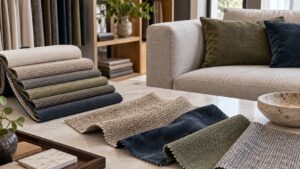
Learn how to assess best quality sofa fabric through use, testing, samples, care, and batch consistency.
View details
Choose Bench Fabric By Seat Load, Surface Structure, Seam Stability, Cleaning Limits, And Installation Details.
View details
Learn how to clean antique chair fabric by checking material condition, care limits, spot testing, and drying risks.
View details