 Elitesofabric
Anti Scratch Sofa Fabric: What To Check Before Buying
0Choose Anti Scratch Sofa Fabric By Checking Weave, Snag Risk, Test Evidence, Cleaning Limits, And Real Samples.
View details
Search the whole station
Standing in front of two sample fabrics that both feel good, it’s easy to first ask which material is more upscale and more durable. However, the sofa is actually subjected to sitting pressure, friction, seam tension, exposure to light, and repeated cleaning. Simply comparing names like cotton, polyester, linen, or velvet often overlooks the fabric structure, surface finish, backing, and post-treatment processes that ultimately determine its performance.
When looking for the best material for a couch, don’t rush to rank the materials just yet. When you place the sofa back in a real-life setting, your judgment becomes much clearer.

The living room’s main sofa is used daily, while the study’s single chair is only used occasionally—these two shouldn’t be treated with the same set of priorities. First confirm the frequency of use, and then look at what the seat surface, backrest, armrest and other parts bear. The seat surface and the front edge are usually more concentrated, and local wear may also occur on the outside of the armrest; the performance of the backrest or decorative pillow cannot replace these high-load parts.
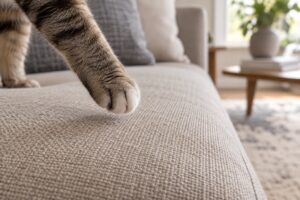
When there are children or pets in the home, you also need to address the risks separately. Scratching, shedding, beverage stains, odors, and cleaning frequency are all distinct issues. For surfaces with obvious loose loops, long floating lines or claw tips that are easy to insert, the risk of hooking should be checked. Tight surfaces can only reduce part of the chance and do not mean absolute anti-grasping.
Light exposure, humidity, and maintenance intervals also influence the selection. The position of strong light exposure should be verified against the finished product’s light fastness. The wet environment can not only see whether the fiber is quick to dry, but also depends on the backing, coating, drying conditions and whether the interior of the furniture is easy to stagnate water.
Polyester has the characteristics of low moisture absorption, quick drying and wrinkle resistance, but “100% polyester” does not indicate weave, gram weight, suede, backing, nor can it automatically prove wear resistance, stain resistance or easy cleaning. Natural fibers such as cotton and flax bring different moisture absorption, touch and appearance tendencies. Whether the finished product is suitable for high-frequency seating still depends on yarn, organization, finishing and specific tests.
Chenille, bouclé, velvet, and jacquard should not be treated as fixed components either. Chenille is mainly made of fancy yarns to form a fluffy surface. bouclé is characterized by knots and loops. Velvet needs to pay attention to velvet direction, lodging and indentation. Jacquard depends on floating length, pattern direction and flower requirements. It’s perfectly fine to like a certain texture, but you should also be prepared to accept and manage the maintenance and appearance changes it entails.
“Durability” is not a single number. Sofa may first appear thin, pilling, hook silk, seam openings, fluff lodging, fading, may also leave a watermark or surface color after cleaning. Ordinary wear resistance results cannot replace pilling, hook wire, breaking strength and seam slip tests, and higher wear resistance numbers do not represent actual service life.
When selecting materials, you can first ask yourself: is the most unacceptable damage, or will it soon become old? Some surfaces are not worn through, but will affect the impression due to indentation, fuzz or changes in the direction of velvet. If the sofa is frequently moved, sat on, or used intensively, its seam integrity and resilience are also worth evaluating separately.
“Easy to clean,” “stain-resistant,” “water-repellent,” and “washable” are not the same thing. Stain resistance focuses on whether dirt is easy to remain, stain release focuses on whether it can be removed after cleaning, and water repellency only describes the surface wetting performance under specific conditions. The fact that the cover is detachable does not mean that it can be machine washed; the cleaning method, temperature, detergent, drying method, size change and appearance after repeated cleaning should be clearly stated.
Confirm with the supplier which cleaning agents are permitted for use and which chemicals are prohibited. Special attention should be paid to the compatibility of suede, coated, and backed materials. Over-wetting may cause dirt to migrate toward the edges, resulting in watermarks, while repeated rubbing can alter the nap direction, polish certain areas, or pull out fibers.
Technical documentation is suitable for eliminating obviously unsuitable candidates, while physical samples are used to verify the differences that can truly be perceived by sight and touch. The sample should be large enough to clearly show the weave pattern, nap direction, or the complete design. Put it on the horizontal seat, vertical back and curved armrest to observe, because the light and direction will change the color, gloss and texture.
Then bend, rub and gently pull the sample in a consistent way to see if the surface is easy to catch, if the pile is obviously changed, and if the fabric can fit the corner. If conditions permit, use the expected dirt and fabric allowed cleaning steps to do small sample comparison, record the color, feel and surface changes after cleaning, rather than just look at whether the stain is light.
The final candidate should provide fiber content, fabric structure, width, mass per unit area, proposed use, maintenance instructions, and test results consistent with the use. The test report should also correspond to the specific model number or batch, and indicate the method, condition, unit and result. Only “heavy duty” or “performance” is not enough to complete the comparison.
Colors must also be confirmed against the approved sample or batch sample. Web page pictures and common color names can only be used for preliminary screening. The same product name cannot guarantee that different batches are completely consistent in color, feel and structure. When a uniform appearance is required for an entire sofa set, you should also confirm the roll number, layout direction, nap direction, and pattern-matching waste.
The really suitable material is not that a certain fiber is dominant in all items, but that the candidate fabric can provide verifiable performance and executable care under your use conditions, and the real sample is still suitable after being placed in various parts of the furniture. After completing these three levels of checks, then decide which model to buy.
Choose Anti Scratch Sofa Fabric By Checking Weave, Snag Risk, Test Evidence, Cleaning Limits, And Real Samples.
View details
Compare Best Stain-Resistant Sofa Fabrics For Families With Kids By Stain Tests, Cleaning Limits, And Durability.
View details
Learn how to assess canvas fabric for sofa use by checking weave, fiber content, seams, care, and sample performance.
View details
Choose Bench Fabric By Seat Load, Surface Structure, Seam Stability, Cleaning Limits, And Installation Details.
View details