 Elitesofabric
Can You Steam Clean Fabric Sofas Without Causing Damage?
0Can You Steam Clean Fabric Sofas Safely? Check Care Codes, Heat, Moisture, Extraction, And Drying Before You Begin.
View details
Search the whole station
When choosing brown fabric for your sofa, the color name can only be considered the starting point. Brown can be reddish or yellowish, or it can be close to brown or light camel. The difference in brightness and saturation will significantly change the temperament of the finished product. Regardless of whether the purchase document states “brown fabric for sofa” or “brown sofa fabric,” it should be addressed to the specific color number, approved sample, or batch sample, and the observation conditions and permissible deviations should be agreed upon. Writing only “brown” makes it difficult to ensure consistency between restocking, splicing, or multiple pieces of furniture.
The right brown couch material depends on where the sofa is placed, how often it is used, whether it is near a window, and whether there are children or pets in the house. For seat surfaces used frequently in daily life, wear resistance, pilling, wire snagging, seam stability, and clean appearance need to be considered simultaneously. Decorative chairs used at low frequencies can place the feel and visual effect further forward. The seat surface, the outside of the armrests, and the front edge typically bear more friction or local stress, and the judgment criteria for the backrest and decorative pillows cannot directly replace these parts.
The same brown fabric may appear in different hues and shades under daylight, warm light, and cool light. When selecting, you can place the sample in the space where the sofa is located, observe it separately during the day and at night, and then compare it close to the floor, wall and wood veneer. Also, allow the sample to cover the horizontal seat, vertical backrest, and curved armrests, as the angle of light and the direction of the surface will change the appearance of the color. Screen images are suitable for initial screening, but cannot replace physical confirmation.
Brown plain, jacquard, short velvet, velvet, velour and microsuede will not have the same effect. A flat surface is usually easier to see if the color is uniform, while the suede surface will change in depth and gloss with the direction of the velvet and the viewing angle. This directional appearance is not necessarily a color difference, but the flannel direction must be uniform when cutting, otherwise adjacent cut pieces may look like they are using different colors.
Touch cannot be separated from structural judgment. Chenille or bouclé can create a soft, fluffy, and layered surface, but exposed loops, fancy yarns, and longer fuzz can increase hooking, dust hiding, or cleaning difficulty. A flat, tight, short-pile surface is generally easier to remove particles, but whether it is easy to care for still requires a combination of post-tidying, stain type, seams, and specific cleaning instructions.
When purchasing brown sand, it is not advisable to compare only one wear resistance. Wear-through, pilling, snagging, seam opening, lint lodging, fading, and cleaning damage are different failure modes and need to be checked separately. Martindale differs from Wyzenbeek in its movement, abrasives, and results; numbers cannot be directly converted or mixed together for ranking. The test report should also specify the specific model or batch, and state the method, conditions, direction, unit, and endpoint.
For dark brown or highly saturated brown, color transfer after wet and dry rubbing and fading under strong light are particularly noteworthy. Laboratory results reflect relative performance under specified conditions and cannot be directly converted into actual service life. Furniture structure, cutting direction, sewing, filling, maintenance methods, and daily usage habits all affect the final performance.
Brown is often considered a low-maintenance option, but whether a stain is noticeable is also affected by the stain color, fabric gloss, texture, pile, and cleaning residue. A darker brown color may soften some of the darker stains, but may make lighter dust, pet hair, scale, or nub marks appear more. A more reliable approach is to use common household beverages, oily foods, or pet contamination to make small-scale comparisons on candidate samples according to permissible care methods, and observe color differences, ring marks, hand feel, and surface changes after cleaning.
The names polyester, cotton, velvet, or microfiber alone cannot determine how a cloth should be cleaned. The same fiber can be woven, dyed, coated, and backed differently, and the care conditions for fixed covers, removable covers, and the entire sofa are also different. Before using aqueous or solvent-based cleaners, pre-test on concealed areas or samples from the same batch to confirm that they will not cause fading, ring printing, hardening, delamination, or changes in the suede surface. Zippered covers are not necessarily machine washable; washability should be supported by clear finished product care instructions and post-wash dimensions, color, seams, and repositioning performance.
After identifying candidate fabrics, the procurement specifications should correspond to the style number, color number, fiber composition, fabric structure, usable width, mass per unit area, direction, batch requirements, recommended use, test results, and care restrictions. Directional pile surfaces must also indicate the normal pile direction; for the same set of sofas or the same space of visible fabrics, compatible batches should be used, and approved samples should be used to check for differences between rolls, inside rolls, and in the edges.
Ultimately, the choice was not to just pick a brown color you liked on the color chart. Only by adapting the color to real light, matching the surface structure with the intensity of use, and then verifying the candidate fabric with specific testing and care conditions can visual effects, durability, and daily maintenance be placed in the same executable solution.
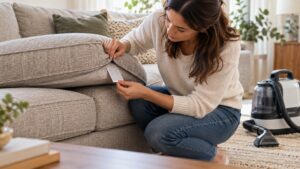
Can You Steam Clean Fabric Sofas Safely? Check Care Codes, Heat, Moisture, Extraction, And Drying Before You Begin.
View details
Learn How To Approve Beige Color Sofa Fabric By Checking Light, Texture, Performance, Cleaning, And Batch Samples.
View details
Choose armchair cloth by checking structure, wear risks, care needs, samples, and relevant test evidence.
View details
Learn How To Choose 4 Seater Recliner Sofa Fabric By Checking Movement, Seams, Wear, Direction, And Care.
View details