 Elitesofabric
Best Material For A Couch: A Practical Selection Method
0Choose the best material for a couch by checking use, structure, durability, cleaning limits, and real samples.
View details
Search the whole station
The most difficult thing to change the fabric of the old sofa is not to measure the length and width with a ruler, but how to "disassemble" a big three-dimensional guy into flat panels that can be tiled and typeset. When calculating the amount of cloth, don't be superstitious about the so-called fixed empirical formula of "a few meters for a single seat and a few meters for a three-person seat". It is far from enough to look at the appearance size. You need to know that the radian of the armrest, the shape of the backrest, how many cushions there are, whether to make the bottom skirt and inlay, plus the orientation of the fabric pattern and the width of the door that can actually be used… These details will directly determine how much cloth you should buy in the end.
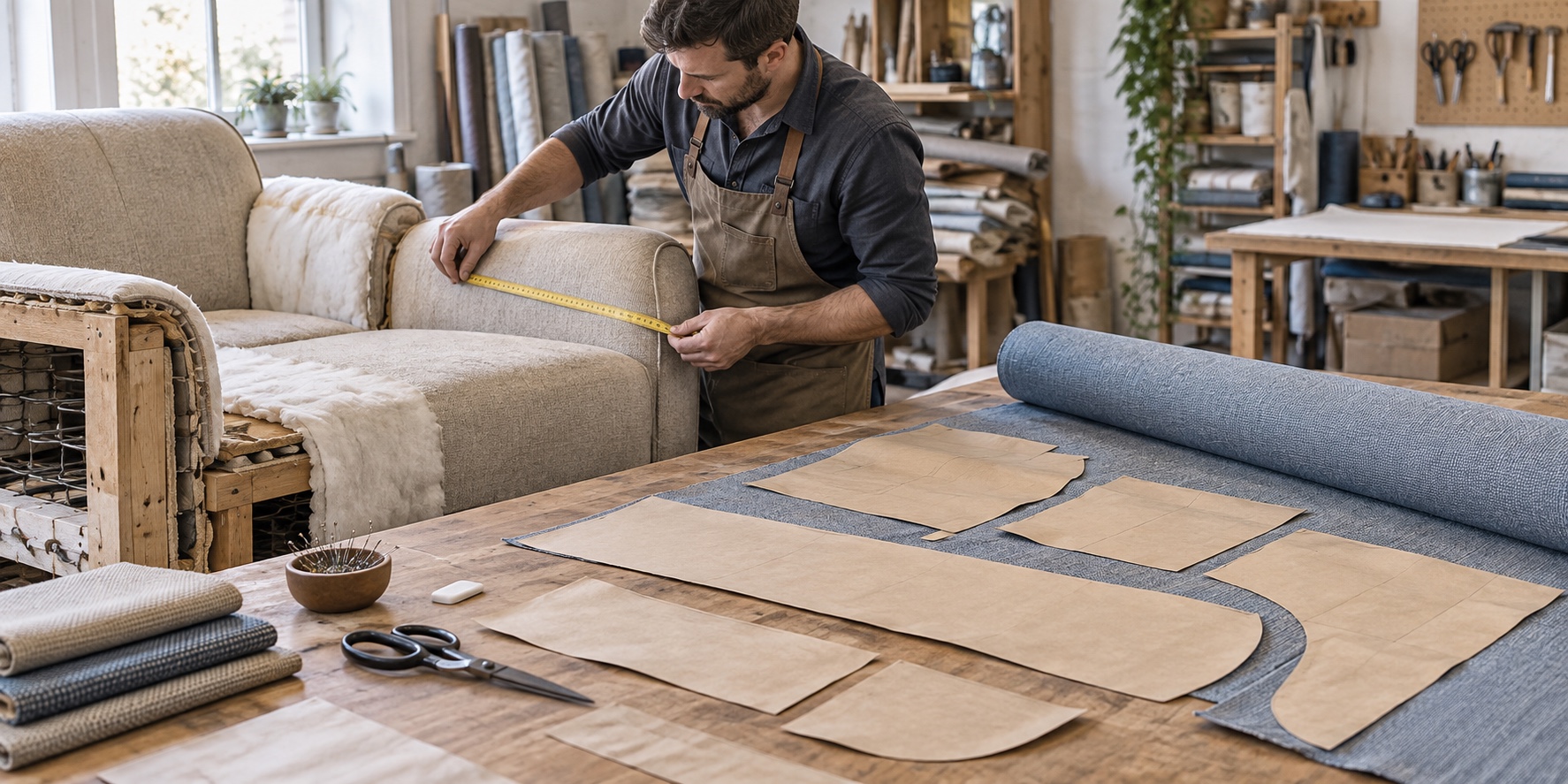
If it is a "dead cover" wrapped on the sofa, it is usually necessary to pull out nails, remove buckles, check the lining and sponge inside, and then cut and fix it step by step. However, if you are making a detachable "looper", you should pay more attention to the allowance in the gap of the sofa, the position of the bottom curling, zipper or other sealing, and also consider the installation sequence. Even if it is facing the same sofa, making dead sets and loopers, the shape of the cut pieces and the cloth that needs to be left are completely different.
Before measuring, set the sofa as usual and put the cushions in their original positions. Remember to take a few more photos from all angles and record the positions of the armrests, backrests, sitting surfaces, each individual cushion, bottom skirt, decorative edges and seams. When taking photos, pay special attention to how the parts are connected, especially the direction and installation sequence of zippers, snaps and open wires. If you encounter the kind of sofa with electric adjustment function, don't miss the position of checking the wiring harness and switch, and be sure to ensure that the range of activities of mechanical parts will not be stuck after renovation.
Measuring the overall dimensions of the sofa is perfectly fine for creating a preliminary cutting list. However, places like those with radians, folds, and hemming lines cannot be accurately reflected by the length and width of the front. In addition to the size of the appearance that the eyes can see, the length that extends to the back or bottom of the sofa for a fixed length should also be written down together.
It is really useful to remove the old fabric as a model and sewing reference, but don't cut it directly. Old fabrics have been used for a long time, and may have been stretched, shrunk, torn, or blindly changed before. The correct way is to remove the stitches first to restore the tight cloth to a relaxed state, and then mark it-where the cloth was originally located on the sofa, the front and back sides, the warp and weft directions, the direction of the reverse hair, which piece of cloth to splice with, whether there is a left-right symmetrical relationship, etc. Once you’ve finished these steps, lay it flat and compare the measured dimensions with the ones you recorded on the sofa earlier. Only when these two sets of data match can you be confident in your pattern piece dimensions.
When using a grading ruler for comparison, be sure to assign a unique number to each pattern piece. Not only should the visible size of the finished product be written in the form, but also the folding margin, seam, quantity, correspondence between left and right parts, and the direction in which cutting is allowed. You should know that the left and right armrests of the sofa, the paired side panels, and the upper and lower pieces of the cushion often need to be cut in "mirror symmetry", or the same grain direction must be maintained. You must not simply calculate the area of a piece and multiply it by the quantity.
In addition, such as edging strips, buckles, bottom skirt, zipper welt and bottom sealing cloth, these small pieces have to be listed separately. Some of them have to be slanted, some have to use long strips of whole cloth, and some have special requirements for texture direction. If you try to save trouble and mix them into a general total allowance, then the cloth will not be enough and you will not even be able to find out where you missed it.
When buying cloth and typesetting, you have to calculate according to the actual "net width" that can be used, and don't rely on the width of the door marked by the manufacturer. The cloth edges on both sides of the cloth, the splicing seams in the cloth roll, and the places with defects will eat up part of the available area. Even 1 the whole roll of cloth, the effective width of different sections may have to be reconfirmed. If you simply add up the area of all the pieces and divide it by the width of the door, the calculated value is only the theoretical minimum-in reality, the pieces cannot fit tightly like a jigsaw puzzle, plus the restriction of texture direction, the arrangement of seams, and the need to avoid flaw points, all of which will continuously increase the length of fabric you need.
If you buy imported fabrics in accordance with the "yard (yard)" pricing situation (1 yard is equal to about 0.9144 meters), the conversion time remember to keep the original number of yards, converted meters, and the final rounding results. Don't round off each piece at the beginning of the 1, or small errors will accumulate and eventually you will definitely be short of weight. The safest way is to finish the overall typesetting, calculate a total, and finally make up according to the minimum order quantity sold by the merchants.
If you use velvet, chenille, suede or other fabrics with inverted hair direction, the hair flow direction of all exposed parts must be basically the same. In order to save cloth, some people turn the cut pieces randomly and cut them randomly. As a result, they found that the same sofa had yin and yang colors or wrong texture, which was very ugly.
If you choose stripes, lattices, large flower patterns or jacquard fabrics, you must write down the horizontal and vertical "flower spacing" (pattern cycle size) to confirm whether it is aligned typesetting, misplaced typesetting or other stresses. In order to "flower", it will not only increase the loss of cloth, but also limit the placement of the main patterns on the backrest, cushion and armrest. As for the "horizontal cutting" often used in the industry (Railroaded, that is, the width of the door is used as the length), unless the pattern direction, fabric width, tensile strength and manufacturer's instructions all allow you to do so, don't try it easily. It is not a universal cloth-saving trick.
Before placing a formal order, it is best to draw a typesetting sketch that can be reviewed at any time, and clearly mark the cloth edge, cloth roll direction, reverse hair, flower position, cut number, mirror image relationship and areas to avoid defects. When calculating the amount, the net amount of cut pieces, the cloth for hair or flower loss, the allowance for defects, the construction surplus, and even the spare cloth for future repair are displayed in different categories. In this way, in case you want to change to another 1 of fabrics, you can also see at a glance which assumptions need to be recalculated.
If several rolls of fabric are used in the same renovation project, be sure to register the net width, net length, batch number of each 1 roll and which piece of furniture it is assigned. Even if it is the same style, as long as it is not the same production batch of cloth, the color and texture may be slightly different, and must not be mixed without distinction in the same typesetting. If after receiving the goods, you find that the actual door width, flower distance or usable length are different from what you thought at the beginning, stop your work and rearrange the layout. Never stubbornly try to reduce the seam allowance or forcibly change the direction of the pattern pieces just to make them fit.
Before putting off the scissors, you may as well make a "trial pendulum" or simulate the assembly of the cut pieces, and check whether the center line is not aligned, the pattern is not smooth, the hair direction is correct, the seam position is not reasonable, whether the surface is fit enough, and also pay attention to whether it will interfere with the activities of mechanical parts. If the cloth is folded too thick at the corner, it will affect the operation of nailing, edging, wood veneer or mechanical mechanism. On the other hand, if the cloth is too thin, it is easy to reveal the color difference, seams and sponge contours under it.
After the cutting is all done, don't rush to throw the packaging away as garbage. The labels, batch numbers, layout drawings and representative leftover materials of the cloth rolls are best kept. For the cloth reserved for future repair, be sure to indicate the front and back sides, direction and which sofa it is, so as not to take the wrong batch or reverse the direction.
After going through this whole process, the purchase volume you get is definitely not the kind of "forehead-beating" data that is divorced from the actual structure, but a set of construction basis that is truly traceable, can be resumed at any time, and can be flexibly adjusted according to the actual arrival situation.

Choose the best material for a couch by checking use, structure, durability, cleaning limits, and real samples.
View details
Choose The Best Fabric For Family Sofa Durability Stain Resistance Comfort Using Care Limits, Samples, And Evidence.
View details
Compare Best Stain Resistant Sofa Fabrics By Stain Type, Cleaning Limits, Test Evidence, And Repeat-Care Performance.
View details
Learn how to assess cat proof sofa fabric through weave, snag risks, test evidence, cleaning limits, and samples.
View details