 Elitesofabric
Beige Fabric for Upholstery: Check Shade, Texture and Use
0Choose beige fabric for upholstery by checking shade, texture, cleaning needs and batch consistency.
View detailsSearch the whole station
When a cat jumps onto the sofa, what often leaves visible marks is not so much the weight of its body as the loops, filaments, or localized deformations pulled out when its claws dig into the surface. Just because a retailer labels a fabric as “pet-friendly” or “scratch-resistant” doesn’t mean it has met a standardized performance rating. When choosing fabric, break down this vague statement into several specific steps that you can observe, inquire about, and compare.
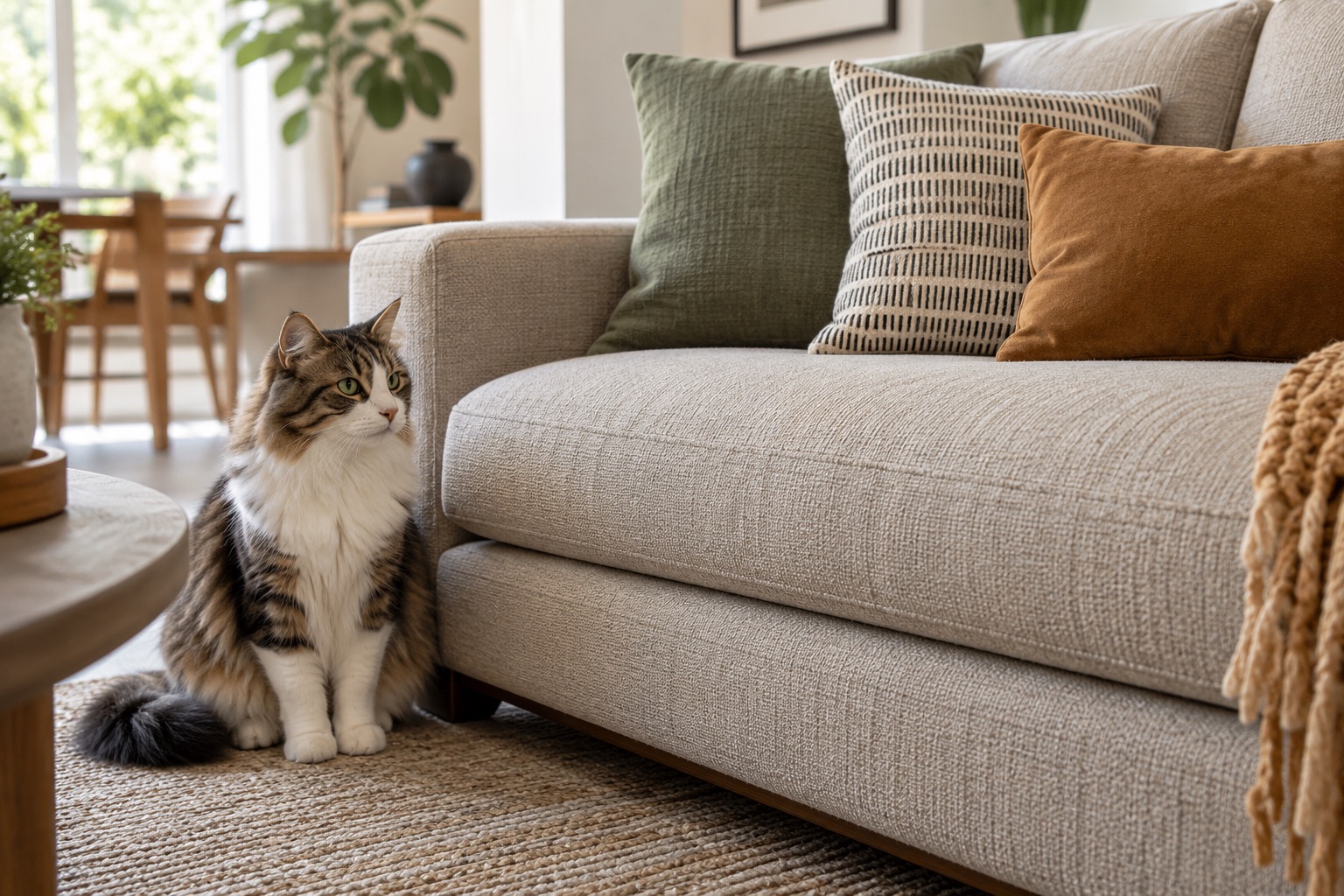
First, clearly identify the primary risks in your household. Will the cat scratch only on the armrests or seat cushions? Is shedding harder to deal with than scratches? Do food, drinks, or pet stains often appear on the sofa? Only by prioritizing claw‑resistance, shedding, stain resistance, and odor control can you determine which feature should take precedence.
When examining a sample, don’t just feel whether it is thick and soft. Put the sample cloth under the side light to see if there are any obvious loose loops, long floating lines, exposed fancy yarns or long fluff on the surface. Such a structure may leave the claw tip an opportunity for insertion and pulling. A tight, flat surface can be used as a primary screening direction because there is less exposed yarn, but it can only reduce the risk of partial hooking and cannot promise that the fabric will not be scratched.
Chenille and bouclé cannot be eliminated by name alone, nor can they be chosen directly because they feel comfortable. When both are used in pet families, the specific structure should be implemented: whether the ring is exposed, whether the velvet yarn is fixed, and whether there will be fluffing, pilling or hooking after repeated friction. The same is true for jacquard, coarse weave and other complex surfaces, where patterns or material names are not a substitute for actual judgment.
Wear resistance, hooking, pilling and seam stability are different issues. The higher abrasion results do not preclude the tip of the claw from pulling out the yarn, nor does it prove that the surface does not fluffy or pilling. When asking for a name like cat proof sofa fabric, you should continue to ask for the specific definition of the statement: what hook or simulation method is used, how many times it is repeated, how to evaluate the appearance, and what damages are not within the scope of the statement.
Seating surfaces, leading edges, and the outside of handrails are usually subjected to more concentrated friction or local stresses. Even if the backrest sample performs well, it cannot directly replace the judgment of the seating surface. High-frequency parts should also be checked together for wear resistance, pilling, seam slippage, fluff change and appearance maintenance after cleaning, so as to avoid one indicator being good-looking, but quickly showing old under the other 1 ways of use.
Small color chips are suitable for seeing colors, but not enough to see the complete texture, velvet direction and hook points. Try to obtain larger real samples, lay them flat, bend them, and stick them close to the seat surface and armrest for observation. Record the original state first, and then compare the surface changes of the candidate sample with consistent actions. This comparison can only help with internal family screening and cannot be used as a general pet certification.
If the supplier provides a scratch-resistant or pet-resistant report, confirm that the result corresponds to the specific model or batch to be purchased, rather than another fabric in the same series. The test method, sample condition, number of repetitions and appearance rating shall also be visible in the report. “Grab-resistant”, “high-performance” or “pet-friendly” without these conditions, are more like marketing labels than verifiable specifications.
Scratches are not the only maintenance costs for pet families. Whether the hair is conspicuous will be affected by the contrast between the color of the pet’s hair and the color of the fabric. Whether the hair is easy to remove is related to whether the surface texture, fluff, static electricity and vacuum tools can touch the gap. You can put a similar number of hairs on each sample, and then use the same allowed cleaning method to compare the hair residue and whether the surface is pulled.
Cleaning tools may also create artifacts. A stiff brush, an incompatible applicator, or a high suction narrow tip may pull out the yarn, change the lint direction, or form localized wear marks. Before selecting the cloth, confirm the allowable cleaning agents and tools, stain treatment methods, drying requirements, and whether there will be color difference or hand change after repeated cleaning. Easy to remove hair is not equal to stain resistance, water repellent, stain resistance, stain release and washable are not the same performance.
Finally put the candidate fabric back to the real furniture to judge. Fixed cover, movable cover and independent cushion have different requirements for extension, recovery, seaming, disassembly and dimensional stability. Armrest, seat surface, backrest and decorative pillow do not need to use the same set of performance priority. There may be a trade-off between soft touch and hook resistance, with high loops, long velvet or soft surfaces in particular depending on where it will be used.
The really reliable option is not to find a sofa that will never leave a cat scratch mark, but to avoid the obvious hook structure in the most frequently stressed parts, and to see the remaining risks clearly with specific samples, tests and care instructions. Before placing an order, it is more useful to confirm the surface tightness, hook, pilling, seams, hair removal methods and cleaning restrictions one by one, rather than just comparing fabric names.
Choose beige fabric for upholstery by checking shade, texture, cleaning needs and batch consistency.
View details
Learn how to clean a fabric chair by checking care codes, testing hidden areas, and controlling moisture and friction.
View details
Can You Steam Clean Fabric Sofas Safely? Check Care Codes, Heat, Moisture, Extraction, And Drying Before You Begin.
View details
Learn how to assess canvas fabric for sofa use by checking weave, fiber content, seams, care, and sample performance.
View details