 Elitesofabric
Beige Fabric for Upholstery: Check Shade, Texture and Use
0Choose beige fabric for upholstery by checking shade, texture, cleaning needs and batch consistency.
View details
Search the whole station
The cloth of the old chair was gray, dust was accumulated in the cracks, and there was a dark trace of unknown origin in some parts. Spraying detergent directly or “washing it 1 times” with steam may save trouble, but it may turn floating dust into watermark, allowing the originally fragile yarn to continue to wear and even make the color migrate to the surrounding.

The most important action before cleaning is not to wipe, but to stop and judge what state the cloth is in.
how to clean antique chair fabric There is no one-size-fits-all set of steps that applies to all antique chairs. So-called antique upholstery fabric may refer to historically preserved original textiles, as well as period reproduction fabrics or contemporary new fabrics styled to resemble antiques. The three have similar appearances, but their care requirements are entirely different.
If the fabric has faded, embrittled, pulverized, fractured, or may be part of the historical material of the furniture, it is not appropriate to apply modern household stain removal, dyeing or intensive cleaning processes. In addition to the original upholstery fabric, linings, padding, stitching, and decorative trim may also qualify as antique upholstery materials. Chairs with high value or unidentified materials are best evaluated by furniture or textile protection personnel before deciding whether to remove dust, local treatment or no intervention.
Take photos from the front, sides, back and near the seat surface to record the stain range, fading, breakage, loose lines, seams and original watermark. Look for the furniture care label and confirm whether the fabric is firmly covered, whether there is a clear cleaning code, and whether the manufacturer allows water-based, solvent-based or vacuum-only treatment. Just because the chair has a zipper doesn’t mean the cover is removable and washable.
At the same time, check for mold, pest infestations, persistent odors, or internal moisture. The soft bag is a multi-layer structure composed of table cloth, backing, filling and wooden frame. The surface treatment cannot prove that the interior is clean or dry. When encountering mold, water damage, biological pollution or large areas of unknown dirt, household treatment should be stopped.
When nursing instructions permit, low-disturbance dust removal may be initiated. Check whether the suction head is clean and the edge is smooth. Use appropriate suction force to deal with the seams, folds and textures in zones. Do not drag the particles back and forth on the cloth surface. For embroidery, long floats, loops or loose yarns, avoid rolling brushes, sharp tips and sticky tools that force across the surface.
Fabrics with a nap or directional texture should be treated in the direction specified by the care instructions. Observe the original dark area after dust removal. Some of them are only particle accumulation or lint direction difference, not stains that need wet cleaning.
Beverages, oils and fats, inks, adhesives, waxes, and molds require different treatment pathways. When the dirt is not clear, only remove the surface solid or absorb the excess liquid that can be safely taken away, do not mix the cleaning agent, and do not continuously expand the wet area for the test effect.
Any cleaning agent should first be tested in an inconspicuous area to observe any color transfer, fading, changes in texture, nap direction, backing, or seam integrity. When local treatment is allowed, the spread is controlled from the outer edge of the stain to the center, and the clean absorbent material is repeatedly sucked instead of being rubbed. The fabric, backing and filling should not be oversaturated; after completion, let the layers fully dry before judging whether they leave a watermark, hardening or color difference.
“Steam cleaning” may refer to hot steam or hot water pumping. Before use, it is essential to verify the actual temperature, moisture content, pressure, extraction, and drying conditions. High temperature and moisture may affect the dye, printing, glue layer, foam and wood veneer. The surface drying out quickly does not mean that there is no water in the interior.
Be especially cautious with old chairs that have fixed upholstery. The fact that household equipment can spray liquid does not mean that the chair fabric allows this method; insufficient extraction may also leave detergent residues, odors and rewet spots.
During pre-test or local treatment, if the clean white cloth brings out the color of the fabric, the cloth surface begins to harden, fluff and polish, the velvet direction cannot be restored, the outside of the stain forms a ring seal, or the seam and backing appear damp change, the scrubbing should be stopped. Do not judge the final color in the wet state after a single treatment, let alone cover the emerging differences with a stronger product.
The truly controllable end point is that the surface cloth, backing and filling are all dry, the color and texture are stable, and there are no new watermarks, residual odors or structural changes. As long as one of them cannot be confirmed, the next step should be left to professionals who understand the historical fabric and soft package composite structure.
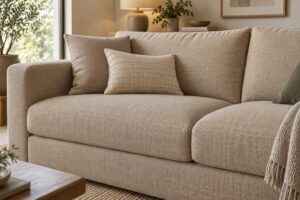
Choose beige fabric for upholstery by checking shade, texture, cleaning needs and batch consistency.
View details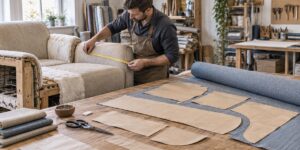
Estimate the amount of fabric to reupholster sofa projects by checking panels, usable width, nap, repeats, and waste.
View details
Can we change sofa fabric? Learn how to assess the frame, upholstery method, fabric fit, yardage, and final checks.
View details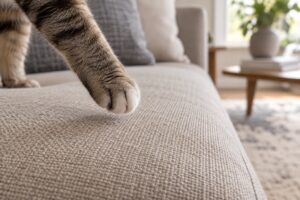
Choose Anti Scratch Sofa Fabric By Checking Weave, Snag Risk, Test Evidence, Cleaning Limits, And Real Samples.
View details