 Elitesofabric
Choosing 4-Seater L-Shaped Sofas Stain-Resistant Fabric
0Learn how to compare 4-seater l-shaped sofas stain-resistant fabric by structure, testing, seams, and care.
View details
Search the whole station
When all four chaise sofas in the showroom are fully extended, the upholstery moves in tandem with the footrests, backrests, and all the individual sections. Cloth that looks flat at rest may accumulate at the fold, be pulled near the seam, or hit the mechanism gap because the stack is too thick. When choosing a cloth, only compare the color, feel and a wear-resistant number, it is easy to miss the conditions that really determine the effect of the finished product.
4-seater recliner sofa fabric is not an independent material grade. It simply indicates that the fabric will be used for a four-seater chaise sofa. What really needs to be confirmed is how the furniture is divided, which seats can be moved, how the fabric is fixed, and what kind of friction, bending and tension each high-load part will bear.

Four seats cannot be directly converted into a fixed amount of fabric. Armrest width, backrest height, footrest design, number of seat cushions, piping, skirt trim, and split modules all affect the cutting pattern. When formally estimating, the dimensions of the seat surface, backrest, armrest, footrest, front block and side panel should be recorded separately, and the folding back, seams, hemming and fixing allowances should be included.
You also need to mark the grain direction of each pattern piece. Plain, directionless fabrics usually have more space for layout; suede, stripes, check and unidirectional patterns cannot be rotated arbitrarily to save cloth. The actual net width, flower return, velvet direction, flower position and defect avoidance of the fabric will all change the final length, so the direct order according to the “universal size of four-person sofa” can only be used as a rough budget, not as a purchase quantity.
The recliner mechanism causes certain parts to repeatedly unfold, fold, and slide. Before fixing the fabric, it is best to do a dry test package to allow the footrest, backrest and connecting parts to complete the full stroke action, and observe whether the new fabric and lining enter the gap, resist the movable parts, or block the switch, wiring harness, and lock Stop and maintenance position.
The thickness can not only look at the single-layer cloth sample. After the fabric, backing, lining, seam and old filling are stacked together, the corners may become hard, the seams may become thicker, and the mechanism gap will become smaller. A fabric that feels soft and smooth when laid flat does not necessarily retain its shape in areas subjected to repeated bending. If the outer skin is bonded to foam, molded or integrated with a structural member, it is also necessary for a person familiar with the structure to judge whether it is suitable for traditional unpacking and refixing.
Seating surfaces, front edges and the outside of armrests are usually subjected to more friction, and movable folding points and joints are also subjected to repeated bending and local tension. Wear resistance test can help to compare the candidate fabrics, but the results of different test methods can not be directly converted, and the higher number of friction does not mean that the actual life must be longer.
A more reliable approach is to check the wear resistance, pilling, hook wire, breaking strength, seam slippage, color fastness to rubbing and appearance changes after cleaning. For knitted or stretch fabrics that are easy to stretch, it also depends on the direction of stretch and the recovery after unloading. If you only look at “can be pulled apart” without looking at the reply, the seat surface may be slack, wrinkled or accumulated cloth. Only looking at the strength of the fabric cannot replace the verification of actual stitch length, stitching, stitching and cutting direction.
The four adjacent seats allow the panel orientation to be more easily compared. Suede, chenille and directional texture fabrics will show changes in light and shade and gloss at different angles; when the direction of adjacent panels is inconsistent, it looks like color difference. Stripes, checks or large patterns also deal with the continuous relationship between the seat center, backrest, footrest and armrests, which will increase the layout restrictions and dosage of flowers.
The same set of furniture should try to use the same batch, roll number, pattern direction and approval sample. Before formal cutting, it is safer to mark the cloth edge, winding direction, velvet direction, flower position, mirror image cut piece and defect area on the layout diagram than to try to adjust after cutting.
Frequency of home use, children or pets, dietary activities, lighting and cleaning conditions change priorities. High-frequency families do not necessarily need the thickest cloth, but need candidate fabrics to maintain a balance in terms of seams, pilling, hook, color fastness and maintenance. Thick loops, long floating lines or obvious fluff can bring tactile and visual layers, but in an environment that is easy to hook, frequently rubbed or frequently removed hair, the surface structure and maintenance difficulty of the actual sample should be observed first.
The cleaning method also corresponds to the final composite structure. The table cloth, backing, foam and wooden frame of the fixed soft bag will jointly limit the water consumption, temperature, cleaning agent and drying method; the fiber itself can withstand certain treatments, which does not mean that the entire sofa can be cleaned in the same way. Before procurement, confirm the specific care instructions and perform a compatibility test on an inconspicuous area or an approved sample.
Give the candidate fabric to the actual construction party and confirm the available width, backing, thickness, stretching direction, sewing, stapling, folding angle and fixing method. The first piece or test package shall check the center line, velvet direction, counterflower, seam, wrinkle, local stress and full stroke of the mechanism, and then decide whether to enlarge the whole set of furniture.
Finally, don’t just ask “is this cloth hard enough”. The more useful question is whether it can be arranged according to the real cutting piece of this sofa, whether it can be bent repeatedly at the movable part, whether the joint can withstand local pulling force, and will not hinder the switch, wiring harness, locking and maintenance. After confirming these items one by one, the cloth selection of the four-seat recliner sofa will fall on the actual structure.
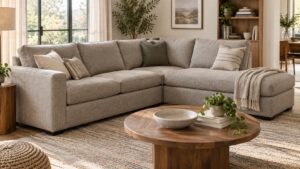
Learn how to compare 4-seater l-shaped sofas stain-resistant fabric by structure, testing, seams, and care.
View details
Choose the best material for a couch by checking use, structure, durability, cleaning limits, and real samples.
View details
Choose the best fabric for furniture by matching use, structure, durability, maintenance, and real sample performance.
View details
Choose The Best Fabric For Sofa With Kids By Checking Stain Tests, Cleaning Limits, Pilling, Seams, And Colorfastness.
View details